
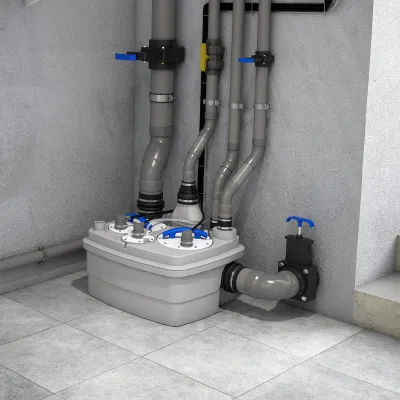

Basements offer valuable additional space in residential and commercial buildings. They can be converted into home theatres, storage rooms, offices, utility areas, guest rooms and even additional bathrooms.
However, one of the biggest challenges associated with basement construction and renovation is wastewater drainage.
Unlike ground-floor or upper-floor bathrooms, basement facilities are often located below the level of the main sewage connection. This makes conventional gravity-based drainage difficult and increases the need for an appropriate wastewater pumping arrangement.
Understanding how basement drainage works can help property owners avoid costly plumbing problems.
Why Basement Drainage Is Different
Traditional drainage systems use gravity to transport wastewater through pipes towards the main sewer connection.
When a bathroom, kitchen or utility room is located below the available drainage level, gravity alone may not be sufficient to discharge wastewater.
This can create several challenges:
- Difficulty connecting basement toilets to the main sewage line.
- Risk of wastewater accumulation.
- Complicated plumbing modifications.
- Limited options for installing additional facilities.
- Potential sewage backflow during periods of heavy rainfall.
These problems become particularly important in commercial basements and buildings with multiple connected fixtures.
Understanding Wastewater Lifting Stations
A wastewater lifting station is designed to collect wastewater in a tank and pump it towards a higher drainage connection.
Once wastewater enters the tank and reaches the activation level, the pump automatically starts discharging it through the connected pipework.
Depending on the equipment selected, lifting stations can manage wastewater from toilets, washbasins, showers, kitchens and other compatible fixtures.
They are commonly used in basements, commercial buildings and locations where gravity drainage is not practical.
Why Equipment Capacity Matters
Not every basement installation has the same requirements.
A small residential bathroom may need a different pumping arrangement compared with a commercial basement containing several toilets, sinks and utility connections.
For larger applications, equipment capacity, operating reliability and maintenance accessibility become especially important.
The SFA Sanicubic 2 Classic is a dual-motor wastewater lifting station designed for larger domestic and commercial applications.
It features two separate pumps that operate alternately, helping distribute operating hours between the motors. Both pumps can also operate together during increased inflow.
The system can handle wastewater from toilets, basins, sinks, washing machines, dishwashers, showers, baths and bidets.
Its pumping capability reaches up to 13 metres vertically, depending on the installation conditions.
Property owners planning basement drainage can explore this wastewater lifting station.
Applications in Residential and Commercial Buildings
Residential basements: Homeowners can use suitable lifting stations to support additional bathrooms and utility facilities.
Hotels: Basement kitchens, laundry rooms and washrooms may require dedicated wastewater management.
Office buildings: Additional basement amenities can be connected to an appropriate pumping arrangement.
Shopping centres: Commercial basements often contain multiple service areas that need reliable drainage.
Educational institutions: Basement washrooms and other facilities require appropriate wastewater disposal systems.
Preventing Basement Drainage Problems
Apart from selecting suitable equipment, property owners should follow several important practices.
First, ensure that the drainage system is designed according to the expected wastewater volume.
Second, install appropriate backflow protection where required by the drainage design and local regulations.
Third, ensure that alarms and control systems are functioning correctly.
Finally, arrange regular inspection and maintenance to identify potential problems before they affect the building.
During the Indian monsoon, basement drainage systems deserve additional attention because heavy rainfall can place extra pressure on municipal drainage networks.
The Importance of Professional Installation
Lifting stations should be selected according to the building’s layout, wastewater characteristics, pumping height and expected inflow.
A qualified professional should assess the installation before equipment is purchased.
Ventilation, electrical supply, pipe sizing and maintenance access should also be considered.
Conclusion
Basement spaces can become valuable parts of residential and commercial buildings when their plumbing requirements are addressed properly.
Wastewater lifting stations provide a practical solution for applications where conventional gravity drainage is difficult.
With appropriate equipment, careful installation and preventive maintenance, property owners can improve basement functionality while maintaining an efficient wastewater management system.